
Introduction: “Celestial Mechanics” From the Solar System to Mechanical Transmission
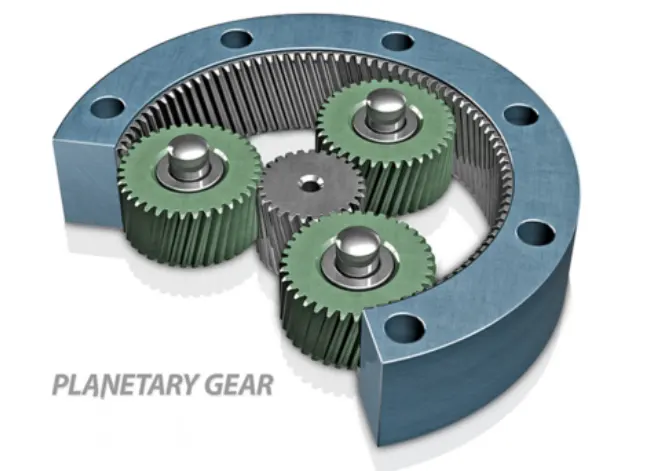
In the vast universe, the trajectories of planets orbiting the sun form a stable solar system. In the sophisticated mechanical world, planetary gearboxes achieve efficient power transmission and speed change through the coordinated movement of the “triple gear code” – the sun gear, the planet carrier and the gear ring. This structure not only simulates the laws of celestial movement, but also, with its advantages of high torque density, compact volume and multi-speed ratio, has become the “transmission heart” of modern industry. From automotive gearboxes to wind turbine gearboxes, from spacecraft to shield machines, the collaborative art of planetary gearboxes is reshaping the future of mechanical transmission.
Cipher One: Sun Gear—The “Core Engine” of Power Input
Structure and Function
The solar gear is located at the geometric center of the planetary gearbox, just like the stars in the solar system, and is the core of power input or output. Its axial direction is fixed and it can rotate through driving sources such as motors and engines, or be driven by planetary gears as the output end.
Design principle
Tooth Count and Speed Ratio: The sun gear’s tooth count (Zs) inversely affects speed. For instance, fewer teeth yield higher rotational speeds, ideal for high-speed applications.
Material Requirements: High-strength alloys (e.g., 20CrMnTi) with surface hardening are essential to withstand contact stress and torque.
Case
In an automatic transmission of a car, the sun gear is directly connected to the engine crankshaft, transmitting the initial power to the planetary gear train and initiating the journey of gear shifting.

Cipher Two: Planet Carrier—The “Orbital System” of Motion Coordination
Structure and Function
The planet carrier is composed of a planetary gear shaft and a support, similar to the orbit of a planet’s revolution. It not only supports the rotation of the planetary gear but also drives it to revolve around the sun. Its core function is to integrate the scattered planetary gear power into a unified output while balancing the radial force.
The Mystery of Mechanics
The design of the number of planetary gears: A uniform distribution of 3 to 6 planetary gears can reduce vibration and eccentric loading. For instance, the four-planetary gear structure is commonly used in the gearboxes of aero engines to ensure stability during high-speed rotation.
Lubrication difficulty: When rotating at high speed, precise oil supply through the oil passage is required to prevent the planetary carrier bearings from overheating, which poses extremely high requirements for the design of the lubrication system.
Example
In the wind power gearbox, the planetary carrier drives the main shaft of the generator to rotate and needs to resist strong wind loads. Its lightweight design and dynamic balance technology directly determine the power generation efficiency.
Cipher Three: Ring Gear—The “Mechanical Framework” of Boundary Control
Structure and Function
The gear ring is a ring-shaped internal tooth structure, fixed in the box or rotatable, and controls the motion mode by meshing with the external teeth of the planetary gear. The fixation of its position or the switching of its driving state is the key to achieving the gear ratio.
Motion control
Fixed gear ring: When driven by the sun gear, the planetary carrier outputs low speed and high torque (such as in the lifting mechanism of a crane).
Drive gear ring: When the sun gear is fixed, the planetary carrier outputs high-speed and low-torque (such as the propeller of a drone).
Linkage mode: The sun gear and the gear ring rotate synchronously, and the planet carrier is locked to achieve direct transmission (such as high-speed gears in a car).
Design Challenge
Internal gear processing technology: High-precision gear hobbing or gear shaping equipment is required, and the gear ring runout error should be controlled within 0.05mm.
Thermal expansion compensation: For large gear rings (such as those used in wind power with a diameter of over 2 meters), an expansion gap should be reserved to prevent thermal deformation and jamming.

Collaborative Artistry: The Dynamic Interplay of the Triple Cipher
Basic transmission model (2K-H planetary gear train)
Speed ratio calculation formula:
i=1+Zr/Zs
Three operating modes emerge by fixing or driving components:
Fixed Ring Gear: Sun gear drives → Planet carrier outputs low-speed, high-torque.
Fixed Sun Gear: Ring gear drives → Planet carrier outputs high-speed, low-torque.
Linked Sun and Ring Gears: Planet carrier locks → Direct drive.
Mechanical Equilibrium
Planetary gear self-balancing: Symmetrical arrangement offsets radial force to prevent the sun gear shaft from bending (such as the load equalization design of the rotary gearbox of an excavator).
Energy loss optimization: Tooth profile trimming and clearance control enable the meshing efficiency to reach over 96%, far exceeding that of ordinary gearboxes.
Application Scenarios: Technical Implementation from Micro to Macro
| Field | Application Case | Key Roles of the Three Gears (Sun Gear, Planet Carrier, Ring Gear) |
| Automotive | Electric Drive Three-in-One Reducer | Sun gear connects to the motor; ring gear is fixed; planet carrier outputs low-speed high torque. |
| Aeronautics | Boeing 787 Main Gearbox | Planet carrier with lightweight design adapts to high-altitude alternating loads. |
| New Energy | 10MW Offshore Wind Turbine Gearbox | Ring gear is fixed; sun gear connects to the impeller; planet carrier drives the generator. |
| Medical Devices | Surgical Robot Joint Drive Unit | Miniaturized sun gear and ring gear; planet carrier achieves sub-millimeter precision. |
Technical Limitations and Breakthrough Directions
Challenges
Manufacturing Precision: Planetary gear synchronization errors >0.02mm cause vibration (e.g., high-speed rail gearbox failures).
Lubrication Complexity: Multi-motion joints demand independent oil circuits, complicating housing design.
Breakthroughs
Advanced Materials: Ceramic-coated sun gears (3x wear resistance), carbon-fiber planet carriers (40% lighter).
Digital Twins: Simulations predict fatigue life (e.g., Siemens’ predictive maintenance for wind gearboxes).
Conclusion
The “triple gear code” of planetary gearboxes reveals a core truth: the essence of mechanical design is not the performance competition of individual parts, but the overall optimization of the structural system. The “core engine” of the solar gear, the “orbital system” of the planetary carrier, and the “mechanical framework” of the gear ring, through the dialectical relationship between restraint and freedom, transform power into function. This system philosophy not only defines planetary gearboxes but also provides inspiration for the entire industrial design – in complex systems, true breakthroughs often stem from a profound understanding of the “art of collaboration”.